
What gets in the way of building diverse leadership teams?
‘Try not to hire in your own likeness. It’s unconscious bias. Quite often people don’t realise they’re doing it.’
Despite the intent many organisations express, building a leadership team that genuinely reflects different perspectives is extremely difficult rarely straightforward.
The panel spoke openly about the habits and pressures that pull leaders back toward sameness, even when they know the value of difference.
Mhairi highlighted one of the most common barriers: the instinct to hire people who think and behave in familiar ways.
Under pressure, leaders often gravitate toward those who mirror their own style. It feels quicker, smoother and easier to manage. But over time, it narrows thinking, reduces challenge and weakens decision-making.
Entrenched cultures and unspoken expectations can shape who feels welcome, who gets heard and who progresses. Without active intervention, teams default to what they already know:
As Mhairi noted:
‘Be very careful of the loudest voice. Be careful of the quiet voice that can get lost.’
Leaders often assume that the loudest contributions reflect the strongest thinking, but volume is not the same as value. The people who add the most insight are not always the first to speak.
Creating the conditions for quieter thinkers to contribute means slowing the pace, asking better questions, and making it clear that contribution is measured by substance, not style.
Shifting away from sameness takes a change in everyday behaviour. Leaders need to challenge their own instincts, set expectations for balanced participation and model the kind of listening they want others to show.
When teams begin to recognise and draw on the full range of talent around them, decision-making becomes steadier, ideas are tested with more care, and progress is built on a far stronger foundation.
How can organisations design fairer, more inclusive hiring for leadership roles?
‘Where are the gaps? What strengths are missing? What do you need as a team to succeed?’
Fair hiring starts long before a role goes live. Bias creeps in at the point where expectations are defined, assumptions go unchallenged, and leaders default to what feels familiar.
Without intention, organisations end up replicating the same profiles and the same perspectives, even when striving for something different.
Inclusive hiring requires actively seeking diverse viewpoints when designing roles and building leadership teams. This means ensuring that all voices are invited into the discussion and that decisions are informed by a broad range of experiences, not just the loudest or most senior opinions.
Listening is as important as asking. Leaders who ask thoughtful questions, and take the time to hear the answers, gain deeper insight and signal that contributions matter.
Simple prompts like ‘tell me more’ can uncover overlooked knowledge, strengthen relationships, and reinforce a culture where people feel seen and heard.
Over time, this creates a virtuous cycle of greater participation, better decisions, and more inclusive leadership outcomes.
How Do You Keep a Shared Culture Alive Across Different Geographies?
‘Culture isn’t what you write down. It’s what people experience when they work together.’
Keeping a shared culture across geographies starts with clear, simple values, but it only works if leaders consistently role-model them.
Values must guide everyday decisions and behaviours, not sit on a wall or a website. When leaders collaborate across functions and reinforce a single organisational identity, teams are less likely to fragment into local silos.
Tony Livesey: ‘We're a premium finance business. All of my engineers understand that. All of our partners understand that. Everybody who works across all the different locations understands that. But then I role model it and I live and breathe it.’
Regular communication rhythms help bring culture to life. Town halls, shared review cycles, and open conversations allow teams to reflect not just on what was delivered, but how it was delivered.
Outcomes achieved at the expense of collaboration or trust ultimately weaken culture and make future cooperation harder.
Distributed and remote work has made cultural signals harder to spot, increasing the importance of structured feedback and sentiment tracking.
Simple tools that surface engagement, morale, and team experience help leaders identify issues early and respond.
Finally, maintaining a shared culture does not mean ignoring local differences. Leaders must adapt their style to different cultural contexts and, where possible, involve local leaders to help translate values into ways of working that resonate across regions.
Leadership Qualities for the Future
‘The more advanced the technology becomes, the closer leaders need to be to their people.’
In a period shaped by post-Covid disruption, remote and hybrid work, and rapid advances in AI, many employees are anxious about relevance, job security, and change. Leaders cannot predict what comes next, but they can remain flexible and stay close to their people.
Human connection is more critical than ever – leaders must resist retreating behind hierarchy or screens and instead invest in relationship-building.
This approach does not scale through one individual alone; it must be embedded and cascaded through middle management so that care, challenge, and support are experienced at every level of the organisation.
‘Language also matters. The words leaders choose shape behaviour.’
Research shows that opportunity-focused narratives encourage experimentation and learning, while fear-based messaging drives people back to safe, familiar ways of working.
In an AI-enabled future, leaders who frame change as possibility rather than threat are more likely to unlock innovation.
Effective future leaders understand that culture and behaviour cascade. How leaders act, speak, and make decisions sets the tone for the entire organisation.
Leadership for the future is therefore not just about adopting new technologies, but about role-modelling trust, curiosity, and compassionate, service-oriented leadership in an era of constant change.
Join the Conversation
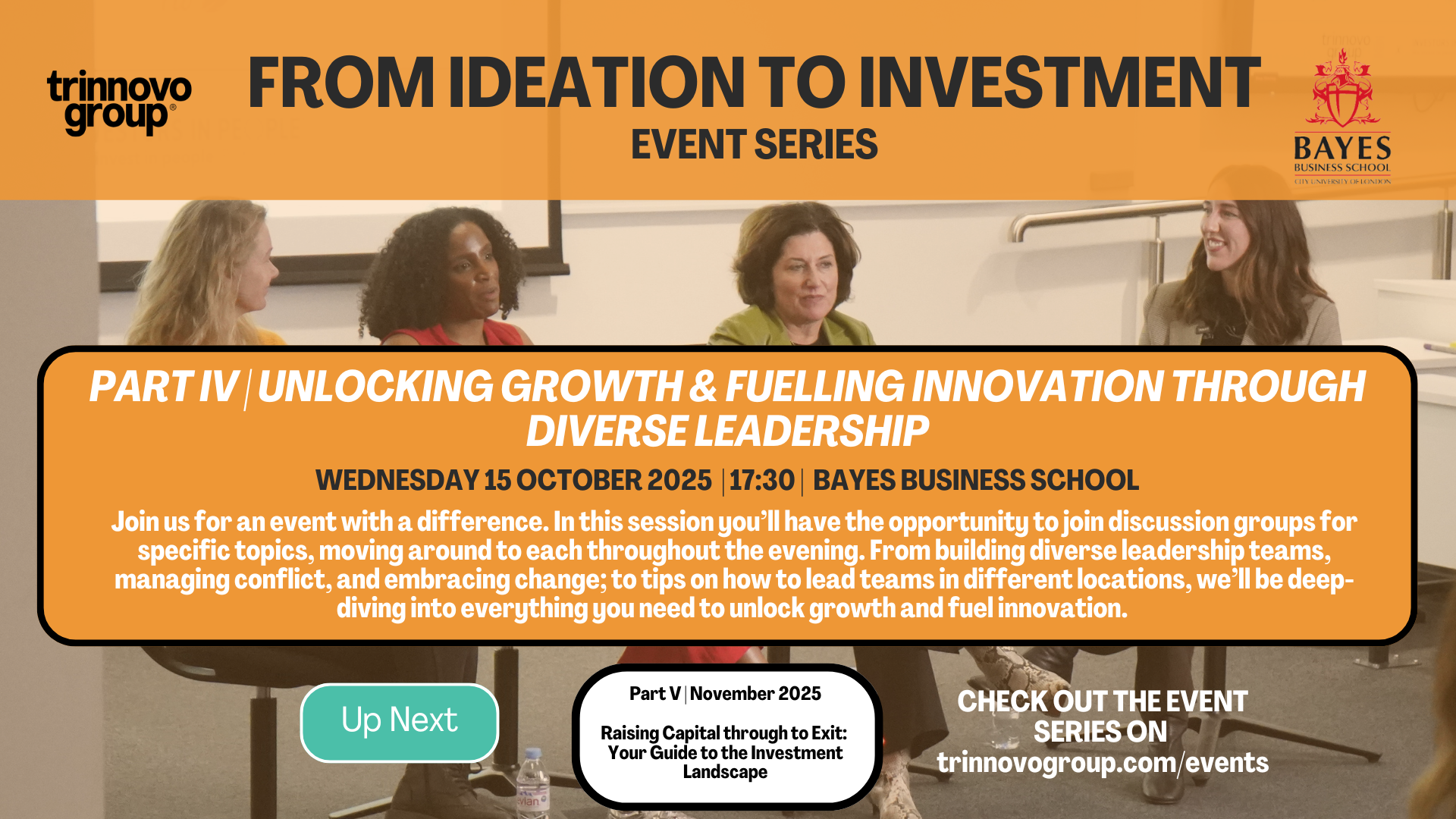
The From Ideation to Investment series, hosted by Trinnovo Group in partnership with Bayes Business School, explores the full lifecycle of building and scaling a sustainable business, from concept to culture to capital.
Each discussion brings together leaders, investors and innovators to share practical insight on every stage of growth: defining your idea, building your brand, positioning in competitive markets and raising investment.
Whichever stage of your entrepreneurial journey you are at, these events offer the chance to learn from leading experts, exchange ideas with peers and build meaningful connections.
Join us for the next session in the series as we continue to explore what it takes to grow businesses that are both profitable and purposeful.
Find out more and register for upcoming events: https://www.trinnovogroup.com/events.